
Begin with the public record your hotel controls
There is no special shortcut that guarantees an AI answer. Search and AI systems need reliable information to understand a property, and travelers need the same information to compare it with confidence.
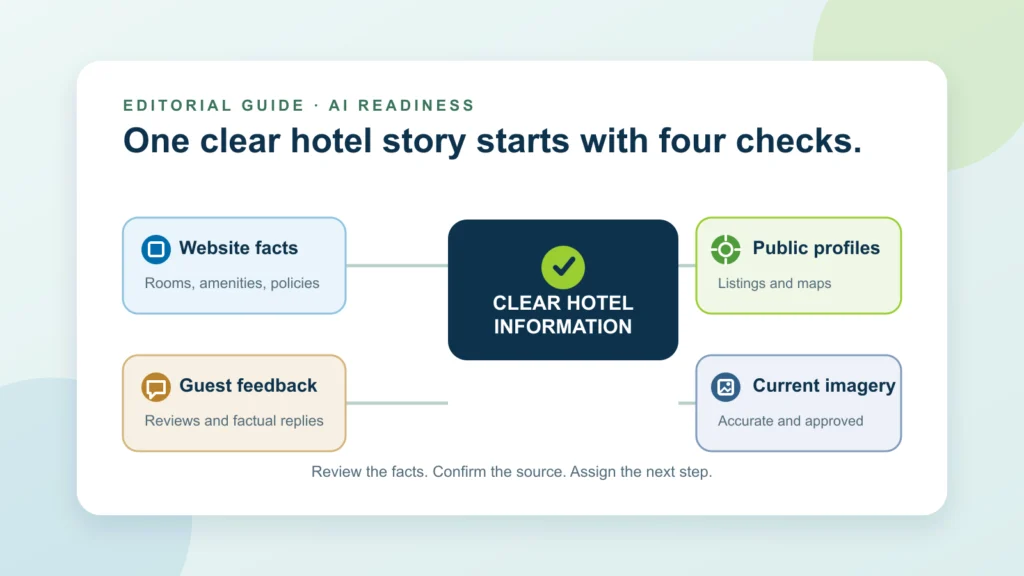
These four checks help a hotel identify where its public story may need attention.
1. Confirm website facts and traveler answers
Review the pages travelers use before they contact or compare the hotel. Check room descriptions, amenities, location details, policies, dining, activities, accessibility information, and the questions the front desk hears most often.
The goal is not to add more words. It is to make approved information complete, specific, and easy to find.
2. Reconcile the Google Business Profile and major listings
Compare the hotel website with the Google Business Profile and the major public listings in scope. Check the property name, address, phone, website, map location, categories, amenities, descriptions, and other visible hotel facts.
When a fact changes, record the approved version and carry it into the right channels. Some platforms require the hotel, platform owner, or an authorized provider to make the final update.
3. Strengthen the flow of current, detailed guest reviews and factual responses
Guest reviews add current, public context about the stay. The hotel should use an authentic, policy-compliant process for inviting feedback and responding to guests.
Review responses should be timely, accurate, and appropriate to the situation. They should not invent facts, disclose private guest information, pressure guests, or create fake reviews. HTB can help organize patterns and recommend approved marketing actions; hotel operations and guest-resolution decisions stay with the hotel.
4. Replace imagery that no longer represents the property
Current professional imagery supports the same factual consistency as room, amenity, policy, and location information. Review the website, approved public profiles, and visible listings for images that are dated, misleading, poorly captioned, or no longer representative of the guest experience.
Use only imagery the hotel has the right to publish. Keep captions, alt text, metadata, and approved rights records aligned with the property guests see today.
Turn the checks into an agreed action list
After the review, organize the findings by priority. Identify the fact or asset to update, who approves it, where it needs to appear, and what should be checked again. That is more useful than chasing a changing list of AI features.
What these checks do not promise
These checks do not guarantee a ranking, AI mention, citation, review score, lead, booking, rate, occupancy, or revenue outcome. They help the hotel maintain a clearer, more accurate marketing foundation.